Pre Engineered Buildings for Industrial and Commercial Projects
Structural Engineering, Controlled Fabrication, and Site Assembly — Integrated into a Unified System
Introduction
Pre engineered buildings have revolutionized industrial construction by integrating structural engineering, controlled fabrication, and site assembly into a unified system. Instead of designing each steel member individually on site, engineers analyze loads digitally, optimize the steel profiles, and fabricate components under factory conditions.
Industrial developers and EPC contractors prefer a PEB structures because they reduce uncertainty in cost, construction time, and structural performance. The system follows codal design principles such as IS 800 for steel design, IS 875 for wind loads, and IS 1893 for seismic considerations, ensuring structural safety under Indian conditions.
Pre engineered steel buildings provide predictable structural behavior, efficient material use, and faster commissioning schedules. These factors directly influence project viability and return on investment.
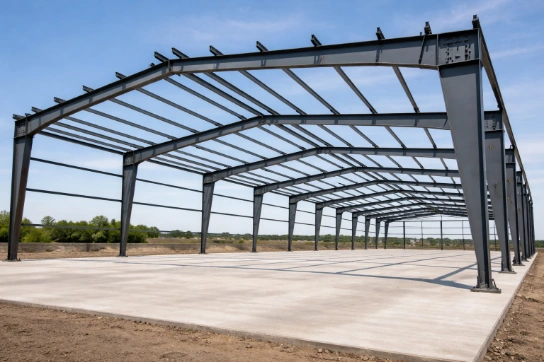
What Is a Pre-Engineered Building
A pre engineered building is a structural system in which the primary and secondary steel members are designed as a complete load-resisting unit before fabrication begins. Engineers determine dead loads, live loads, wind loads, crane loads, and seismic forces during the design stage.
The system consists of:
-
 Primary rigid frames made of tapered built-up sections
-
Secondary members such as purlins and girts
-
Roof and wall cladding systems
-
Bracing systems for lateral stability
-
Engineered connections and anchor bolt assemblies
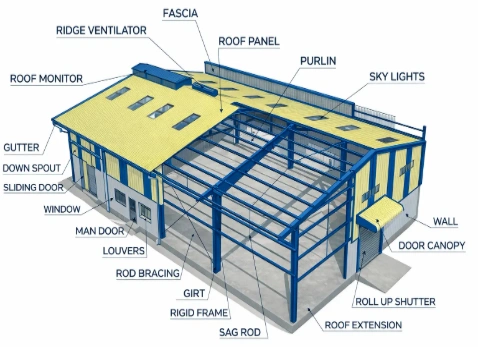
Unlike conventional hot-rolled steel framing, a pre-engineered metal building uses variable depth sections. Engineers increase steel thickness where bending moments are higher and reduce it where forces decrease. This approach improves structural efficiency and reduces unnecessary steel weight.
Authoritative industry bodies such as the Metal Building Manufacturers Association (MBMA) and the American Institute of Steel Construction (AISC) publish technical guidance on metal building systems, supporting the engineering methodology widely adopted in modern PEB structures.
Key Features of KMS PEB Structures
Optimized Primary Framing System
We design primary frames using built-up welded sections tailored to span length, bay spacing, and loading conditions. The tapered configuration aligns with the bending moment diagram, improving structural efficiency.
This method ensures:
-
Reduced steel tonnage without compromising strength
-
Controlled deflection under service loads
-
Improved resistance to lateral forces
-
Efficient load transfer from roof to foundation
Engineers analyze frames using structural software validated against codal provisions to verify stress limits and serviceability criteria.
Secondary Structural Members
Secondary members distribute loads from cladding to the primary frame. These include Z and C purlins for roofs and girts for walls.
They serve critical structural functions:
-
Transfer wind suction and gravity loads
-
Prevent local buckling of cladding sheets
-
Stabilize primary members
-
Support diaphragm action of roof systems
Proper spacing and bracing prevent vibration, oil canning, and long-term deformation issues in prefabricated structures.
Roof and Wall Cladding Systems
Cladding systems in pre-engineered steel buildings act as protective envelopes and structural diaphragms. We integrate profiled metal sheets, insulated panels, and fastening systems based on thermal and environmental requirements.
Key considerations include:
-
Wind uplift resistance
-
Water tightness
-
Thermal performance
-
Long-term corrosion resistance
Correct fastening patterns and lap detailing ensure performance during high wind events, as defined under IS 875 wind load provisions.
Integrated Crane and Mezzanine Provision
Many industrial buildings require overhead cranes. We design crane-ready PEB structures by incorporating bracket plates, runway beams, and lateral bracing during initial analysis.
Crane load analysis includes:
-
Vertical wheel loads
-
Impact factors
-
Lateral surge forces
-
Longitudinal braking forces
Early integration prevents costly structural retrofits.
Engineered Connections and Erection Efficiency
Connection detailing influences structural stability during erection. We design bolted end-plate connections for fast assembly and accurate alignment.
Pre-drilled members and marked components ensure systematic site erection. This controlled process reduces site welding and improves safety compliance.
Applications of Pre-Engineered Buildings
Pre engineered buildings serve diverse industrial and commercial sectors due to their structural adaptability.
Common applications include:
-
Manufacturing plants
-
Logistics and warehousing facilities
-
Cold storage units
-
Automobile workshops
-
Aircraft hangars
-
Commercial showrooms
-
Industrial sheds
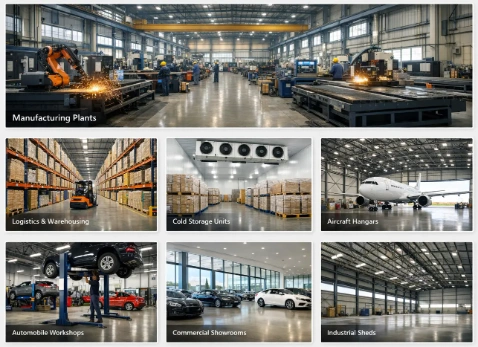
Wide, clear spans provide uninterrupted floor space, supporting material handling systems and production lines. Multi-span configurations are suitable for larger footprints where column grids align with operational workflows.
Our Manufacturing Capabilities
Manufacturing precision determines long-term structural reliability. We operate fabrication systems that ensure dimensional accuracy and welding quality.
Our capabilities include:
-
CNC cutting and drilling lines
-
Automatic submerged arc welding for built-up sections
-
Shot blasting for surface preparation
-
Controlled painting systems for corrosion protection
-
Quality inspection at each production stage
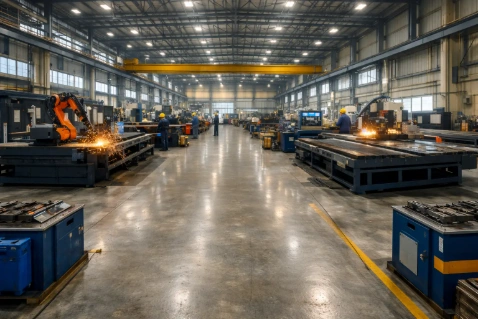
Factory fabrication ensures repeatability and minimizes material waste. Each prefabricated steel structure building component is inspected before dispatch.
Advantages of Pre-Engineered Buildings
The advantages of preengineered buildings extend beyond construction speed. The system delivers measurable engineering and financial benefits.
-
Structural Efficiency : Engineered tapered sections match material usage to
stress distribution, reducing excess steel and improving load performance.
-
Faster Construction : Parallel design and fabrication shorten project
timelines. Site assembly begins as soon as the foundation is ready.
-
Cost Predictability : Factory fabrication controls material quantities and
minimizes site variation.
-
Scalability and Expansion : Future expansion is feasible because engineers
plan for additional bays during the initial design.
-
Quality Control : Factory conditions enable inspection, controlled welding,
and consistent coating thickness.
Industry research from MBMA indicates that metal building systems reduce construction schedules compared to conventional structural approaches due to integrated design and fabrication processes.
Why Choose KMS Technologies
Industrial construction requires structural clarity and predictable outcomes. We approach every pre engineered building project with engineering validation, manufacturing precision, and structured execution.
Our methodology includes:
-
Load-based structural modeling before fabrication
-
Transparent material specification
-
Detailed connection drawings
-
Structured quality checks
-
Coordinated site support during erection
We design every PEB structure to meet Indian climatic and seismic conditions while maintaining practical constructability.
Project managers and procurement heads require certainty in structural performance, cost control, and compliance. Our approach addresses these parameters systematically.
Get a QuoteFAQ
Ready to Start Your Next Project?
Let our state-of-the-art facilities and expert team bring your vision to life.