Second Structural Systems in Steel Buildings
Load Transfer, Stability, and Serviceability — Engineered for Industrial Performance
Primary steel frames carry the main gravity and lateral loads in a steel building. However, the structure does not perform safely without an engineered second structural system.
Second structural components transfer loads from roof and wall cladding to the main frames. They stabilize compression members, control deflection, and ensure proper load path continuity.
In pre engineered buildings, improper detailing of second structural elements often leads to serviceability issues such as excessive vibration, sheet deformation, connection distress, and progressive instability. A properly engineered second structural system eliminates these risks and ensures predictable structural behavior.
This page explains how second structural systems function, how each component behaves under load, and how KMS Technologies designs these systems for industrial steel buildings.

Second Structural Systems in Steel Buildings
Second structural systems include cold formed and hot rolled members that support cladding and distribute loads to primary frames. These elements directly influence global stability and local member performance.
Key second structural components include:
-
 Purlin and Girts
-
Eave Struts
-
Open Web Joists
-
Cable, Angle, Rod, and Tube Bracing Systems
Each element serves a specific structural purpose. Together, they create an integrated load transfer mechanism that supports gravity loads, wind loads, and seismic effects in accordance with established structural design principles and building codes such as IS 800 and IS 875.
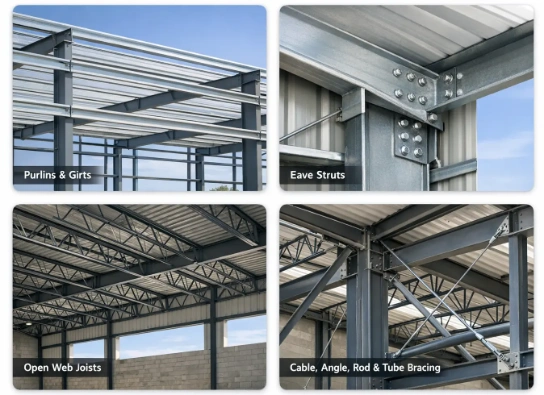
Purlin and Girts
Purlins and girts form the backbone of the roof and wall support system in any secondary structural framework. While primary frames carry major loads, these secondary members ensure that roofing and wall systems perform safely under actual operating conditions. In pre engineered buildings, the stability and serviceability of the entire envelope depend heavily on the correct design and spacing of purlins and girts. Without them, cladding systems would lack structural continuity and load transfer paths.
Structural Role
Purlins run parallel to the ridge along the roof slope. They support roof sheets
directly and transfer gravity and wind loads to the main rafters.
Girts run horizontally along the wall. They support wall cladding and transfer
lateral loads to the columns.
Together, they perform several critical structural functions:
-
Support roof and wall cladding systems
-
Transfer dead, live, and wind loads to primary members
-
Reduce the effective buckling length of columns and rafters
-
Improve overall frame stiffness
-
Act as diaphragm connectors when integrated with sheeting
Structural Behavior
Cold-formed Z and C sections are commonly used as purlins and girts in modern steel buildings. Designers prefer these sections because they provide high strength with reduced weight. Section depth and thickness are selected based on engineering calculations, not assumptions.
Design parameters include:
-
Roof slope
-
Bay spacing
-
Load combinations
-
Deflection criteria
-
Uplift forces
Eave Struts
Eave struts connect roof purlins and wall girts at the building perimeter.
Structural Function
-
Transfer roof loads to side wall columns
-
Provide edge stiffness
-
Resist wind suction at roof edges
-
Support gutter systems
The eave region experiences complex stress conditions due to uplift, torsion, and eccentric loading. Engineers design eave struts to resist combined bending and torsion while maintaining cladding alignment.
Improperly sized eave struts can cause distortion at roof edges and leakage issues. A properly detailed eave member ensures continuity between roof and wall systems.

Open Web Joists
Open web joists support roof decks and create larger clear spans without excessive steel weight.
Structural Purpose
-
Support distributed roof loads
-
Reduce structural dead load
-
Allow service integration
-
Improve material optimization
The triangulated web configuration transfers axial forces efficiently through tension and compression members. This reduces bending demand compared to solid sections.
Open web joists also allow mechanical ducts, lighting, and fire systems to pass through the web openings. This improves functional efficiency in industrial facilities.
Design references such as the Steel Joist Institute (SJI) emphasize load rating, connection detailing, and deflection control to ensure long term performance.

Cable, Angle, Rod, and Tube Bracing
Bracing systems stabilize the structure against lateral forces.
Structural Role
-
Resist wind and seismic loads
-
Provide longitudinal stability
-
Prevent frame sway
-
Control torsional rotation
Bracing forms a triangulated load path. When lateral forces act on the building, bracing members develop axial tension or compression forces and transfer them to foundations.
Types of Bracing
Rod Bracing
Used in roof and wall planes for lightweight lateral resistance. Rods work primarily in tension and are economical for low-to-medium lateral loads.
Cable Bracing
Suitable where only tensile resistance is required. Cables reduce dead weight on the structure but require careful pre-tensioning during erection.
Angle Bracing
Resists both tension and compression when designed properly. Hot rolled angles are widely used due to their availability and ease of connection detailing.
Tube Bracing
Provides higher axial stiffness and better compression capacity. Used in larger industrial spans where slenderness ratio control is critical.
Engineers must consider slenderness ratio, connection detailing, and load reversal under seismic forces as outlined in IS 1893.
Key Features of Second Structural System
A well-designed secondary structural system improves load distribution, stability, and long-term building performance. It strengthens the connection between cladding and primary framing while optimising steel usage and serviceability.
Load Transfer Efficiency
-
Creates a continuous load path from cladding to foundation
-
Distributes wind suction and gravity loads uniformly
-
Reduces localised stress concentrations at supports
-
Enhances diaphragm action of roof and wall systems
-
Improves load sharing between adjacent framess
Structural Stability
-
Control lateral displacement of primary frames
-
Reduce unbraced length of compression members
-
Provide flange restraint to rafters and columns
-
Enhance torsional stability of primary members
-
Prevent progressive structural instability
Serviceability Control
-
Limit roof deflection within code limits
-
Minimise vibration under wind and operational loads
-
Protect cladding from distortion and oil canning
-
Prevent water ponding on roof surfaces
-
Maintain panel alignment and fastener integrity
Material Optimization
-
Uses cold formed sections for weight efficiency
-
Optimise spacing based on structural demand
-
Reduce primary steel tonnage through restraint
-
Improve structural continuity and redundancy
-
Enhance cost-to-performance ratio
Applications of Second Structural Systems
Second structural systems support diverse industrial and commercial buildings.
Industrial Warehouses
-
Large clear spans
-
High wind uplift resistance
-
Integrated crane support
Manufacturing Plants
-
Roof mounted equipment
-
Mezzanine integration
-
Heavy service loads
Logistics & Distribution
-
Wide bay spacing
-
Dock openings
-
Diaphragm action for lateral resistance
Commercial Steel Buildings
-
Architectural wall systems
-
Service corridors
-
Integrated drainage systems
Advantages of Second Structural Systems
A properly engineered secondary structural system enhances overall building performance and increases lifecycle reliability. It integrates cladding, secondary members, and primary frames into a coordinated structural mechanism. When correctly designed, it supports stability, durability, and long-term operational efficiency.
Key performance benefits include:
-
Reducing maintenance associated with sheet deformation by controlling deflection and
minimising distortion in roof and wall panels
-
Improving fatigue resistance under repeated loads by distributing stress more evenly
across secondary members
-
Maintaining serviceability under wind uplift through appropriate restraint, connection
detailing, and load path continuity
-
Optimising steel usage without compromising safety by balancing strength, stiffness,
and
structural demand

Why Choose KMS Technologies
KMS Technologies engineers secondary structural systems using a performance-driven design approach
focused on real load behaviour and practical site execution.
We do not treat purlins, girts, eave struts, and bracing as secondary accessories. They directly
influence global stability, serviceability, and long-term performance of a PEB building. Our
engineering process evaluates how each component interacts with the primary frame and cladding
system.
We focus on the following engineering priorities:
-
Clear load path modelling We establish a continuous load path from cladding to foundation. Wind uplift, gravity loads, and lateral forces transfer efficiently without creating stress concentrations.
-
Deflection control analysis We evaluate roof and wall deflections under service loads. Controlled deflection protects cladding, prevents ponding, and reduces sheet deformation.
-
Integrated bracing design We design bracing systems that work with the primary frame to resist lateral loads and maintain stability throughout construction and service life.
-
Connection detailing accuracy We develop precise connection details to ensure constructability and structural reliability. Accurate detailing prevents site adjustments and fabrication delays.
-
Code compliant structural checks We perform rigorous structural checks according to relevant codes and standards. Every component is verified for strength, stability, and serviceability.
Our Related Services
Explore our complete range of pre-engineered building solutions

Structural Designing
Comprehensive PEB structural design covering primary frames, wall systems, and load transfer mechanisms engineered to IS 800:2007 and IS 875 for safe, cost-efficient buildings.
Explore Structural Designing
Standard Frame Type
Conventional clear-span and multi-span rigid frames engineered for standard load conditions, providing predictable structural performance.
View Standard Frame Types
Accessories & Crane System
Overhead crane-ready structures with integrated runway beams, bracket plates, and accessories designed for demanding material-handling environments.
Explore Crane & Accessories
Mezzanine Systems
Steel intermediate floor platforms engineered to IS 800 for warehouses, manufacturing plants, and logistics hubs — maximising vertical space.
Explore Steel Mezzanine Systems