Accessories and Crane System for Pre-Engineered Buildings
Structural Accessories and Crane Solutions That Define Industrial Performance and Safety
An efficient accessories and crane system defines the operational capability and structural reliability of an industrial building. In pre engineered building projects, these components are not optional add-ons, they influence load transfer paths, structural stability, serviceability performance, and long-term maintenance cycles.
Crane systems introduce dynamic vertical and horizontal forces into the primary frame. Accessories ensure structural continuity, weather protection, operational safety, and controlled load distribution. Every connection, bracket, rail, and fastening element must comply with the structural design intent and relevant Indian Standards such as IS 800:2007, IS 875 (Parts 1–5), and IS 807 for crane structures.
This page explains how crane systems integrate into steel structures and how PEB accessories support performance, safety, and durability in industrial applications.

Crane System in PEB Structures
A crane system enables internal material handling within industrial facilities. It supports manufacturing workflows, reduces manual handling risk, and improves operational efficiency.
From a structural engineering perspective, crane systems impose:
-
 Vertical wheel loads
-
Longitudinal surge forces
-
Transverse lateral forces
-
Impact factors
-
Fatigue-inducing repetitive loads
Design engineers must calculate these forces as per IS 875 (Part 2) for imposed loads and follow crane load considerations defined in IS 807 and IS 3177. The primary frame, crane brackets, and runway beams must safely transfer these forces to columns and foundations without exceeding permissible deflection limits under IS 800:2007.
Crane integration requires coordination between structural analysis, connection detailing, fabrication precision, and erection alignment.
Types of Crane Systems
EOT Crane System (Electric Overhead Traveling Crane)
EOT cranes operate on runway beams supported by building columns. They are commonly used in heavy manufacturing plants, fabrication workshops, and warehouses.
Structural characteristics:
-
Crane brackets welded or bolted to primary columns
-
Runway beams designed for vertical and lateral wheel loads
-
Horizontal bracing systems for surge control
-
Deflection control as per span and capacity
EOT cranes require precise alignment and tight tolerance control during erection to prevent wheel misalignment and excessive wear.
Single Girder Crane System
Single girder cranes support moderate lifting capacities and shorter spans. They impose comparatively lower loads on the structure.
Engineering considerations:
-
Economical runway beam sizing
-
Controlled lateral drift
-
Reduced bracket depth
-
Suitable for light to medium-duty industrial operations
They integrate efficiently into standard industrial PEB frames.
Double Girder Crane System
Double girder cranes handle higher capacities and longer spans. They generate greater wheel loads and require enhanced column and bracket stiffness.
Structural implications:
-
Increased flange thickness in crane runway beams
-
Enhanced web stiffeners
-
Higher lateral bracing demand
-
Strict vibration and fatigue checks
Engineers must verify lateral torsional buckling resistance of runway beams under repeated dynamic loads.
Underslung Crane System
Underslung cranes suspend from roof members or lower flange beams. They suit smaller industrial units where floor-mounted crane columns are impractical.
Key considerations:
-
Roof beam capacity verification
-
Connection reinforcement
-
Serviceability deflection limits
-
Load distribution through secondary members
This system requires detailed load path analysis to prevent overstressing roof framing.
PEB Accessories and Their Structural Role
Accessories in steel buildings support structural integrity, environmental control, and operational functionality. Flip each card to explore the engineering role of every component.
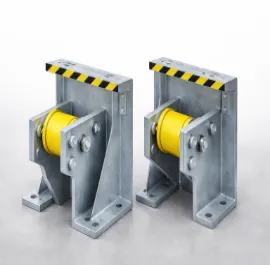
Crane Brackets
- Transfer crane loads from runway beams to primary columns
- Resist vertical wheel reactions and lateral surge forces
- Prevent local flange buckling
- Design follows IS 800 bending, shear and weld checks

Crane Runway Beams
- Carry crane wheel loads and distribute forces into the structure
- Control vertical deflection and resist lateral torsional buckling
- Handle fatigue stress cycles and maintain alignment tolerance
- Stiffener placement ensures web stability under concentrated loads

Sag Rods
- Stabilize purlins and girts against minor axis bending
- Reduce effective unbraced length and control lateral displacement
- Improve load sharing among secondary members
- Enhance serviceability under IS 875 (Part 3) wind loads

Bracing Systems
- Ensure global structural stability (cross, rod, portal, knee bracing)
- Resist wind and seismic forces per IS 1893 (Part 1)
- Transfer lateral forces to foundations reliably
- Critical for frame stability under dynamic loading

Turbo Ventilators
- Expel hot air and improve internal airflow naturally
- Create localized roof openings requiring local reinforcement
- Must maintain water tightness and not compromise sheet strength
- Installation must preserve purlin spacing and roof diaphragm action

Louvers
- Provide controlled ventilation in wall and roof panels
- Require framing reinforcement and wind load resistance
- Proper fastening prevents vibration under wind loads
- Designed for water penetration control and durability

Ridge Vent
- Enhance passive ventilation along the roof peak
- Maintain roof diaphragm continuity and resist uplift loads
- Prevent leakage at the ridge line
- Accommodate thermal movement along roof length

Flashings and Trims
- Protect building joints and edges from water ingress
- Protect insulation layers from moisture damage
- Improve long-term corrosion resistance at junctions
- Maintain sheet edge stability under wind and thermal loads

Anchor Bolts
- Transfer column loads to the foundations
- Resist uplift forces and shear forces simultaneously
- Maintain alignment tolerance during column erection
- Meet embedment requirements per structural design

Gutters & Downspouts
- Manage rainwater drainage from roof surfaces
- Prevent roof edge corrosion and foundation erosion
- Handle rainfall intensity per IS 875 (Part 5)
- Designed with proper slope and capacity for peak discharge

False Ceiling Systems
- Suspended grid systems for office and industrial interiors
- Improve acoustic performance and thermal comfort
- Conceal electrical, HVAC, and structural elements
- Lightweight hangers transfer loads to secondary members

Glass Wool Insulation
- Fiberglass roll with aluminium foil facing for roof and wall systems
- Reduces heat transfer and improves energy efficiency (BEE guidelines)
- Controls condensation in cold storage and climate-sensitive buildings
- Installed within built-up roof and wall cladding assemblies
Structural Integration of Accessories and Crane System
Accessories and crane systems must function as an integrated structural unit. Engineers must verify:
-
Load path continuity
-
Member capacity
-
Connection detailing
-
Fatigue performance
-
Erection tolerances
-
Corrosion protection
Fabrication accuracy and site alignment directly affect service life.
Applications
Accessories and crane systems support various industrial sectors:
-
Steel fabrication plants
-
Automotive manufacturing units
-
Heavy engineering workshops
-
Logistics and warehousing facilities
-
Cement and process industries
Each application requires tailored load calculations and structural detailing.
Our Related Services
Explore our complete range of pre-engineered building solutions

Structural Designing
Comprehensive PEB structural design covering primary frames, wall systems, and load transfer mechanisms engineered to IS 800:2007 and IS 875 for safe, cost-efficient buildings.
Explore Structural Designing
Second Structural
Purlins, girts, and eave struts that distribute cladding and wind loads to the primary frame while stabilising the structural system.
Explore Second Structural Systems
Sandwich Roof and Wall Panels
Profiled metal sheets and insulated panel systems engineered for wind uplift resistance, water tightness, and long-term corrosion protection.
Discover Sandwich Panels
Mezzanine Systems
Steel intermediate floor platforms engineered to IS 800 for warehouses, manufacturing plants, and logistics hubs — maximising vertical space.
Explore Steel Mezzanine Systems